Transforming Stress Management Training for Employees
Recently, I had the privilege of stepping into the historic halls of the University of Oxford to deliver a keynote on a subject that has never felt more urgent: stress management training for employees, and the wider conversation around managing workload, stress, and burnout within modern workplace culture.
Standing in a place synonymous with high performance and intellectual rigour, I was reminded that regardless of the setting: whether it is a prestigious university or a fast-paced corporate office: the human nervous system remains the same. We are all operating with biological hardware that was never designed for the “always-on” digital landscape we find ourselves in today.
As a mental health keynote speaker, my goal is always to bridge the gap between clinical psychological theory and the practical, everyday realities of the workplace. The invitation to Oxford was a reflection of a growing, global appetite for conversations that go beyond surface-level wellbeing. Organisations are beginning to realise that the traditional “resilience” model: which often places the burden of “fixing” stress solely on the individual: is no longer enough. More leaders are recognising that meaningful stress management training for employees has to address both personal regulation and the systems people work within.
The Reality of the Modern Workload
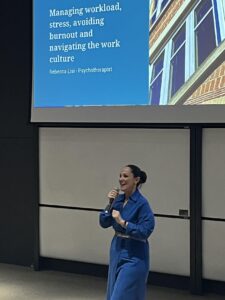
During the session, we explored the psychological realities of modern working life. While productivity and performance are often the metrics we prioritise, we rarely give the same attention to the human nervous system underneath it all. This is the part of us responsible for coping with pressure, managing emotions, making decisions, and sustaining energy over time.
When we ignore the biological limits of our nervous system, we enter a state of chronic dysregulation. This isn’t just about “having a bad day.” It is a physiological state where the body remains in a high-alert “fight or flight” mode, even when the immediate threat has passed.
One of the key themes I shared at Oxford is that burnout rarely happens overnight. It is a “quiet erosion”: a slow development driven by chronic stress, emotional overload, and unrealistic expectations. Many of the attendees resonated with the idea that our nervous systems have forgotten how to truly switch off.
The Subtlety of the “Slow Build”
In my work providing stress management training for employees, I often see that the earliest signs of burnout are subtle. They are easily dismissed as “just a busy month” or “feeling a bit tired.” However, if we look closer, we can see the nervous system struggling to regulate itself.
Common indicators include:
- Difficulty concentrating: The brain’s prefrontal cortex, responsible for executive function, begins to go offline when we are chronically stressed.
- Emotional exhaustion: Feeling “flat” or unable to experience joy in tasks that used to be fulfilling.
- Irritability: A shortened “window of tolerance” where small setbacks feel like major catastrophes.
- The “Mentally Stuck” feeling: A lack of motivation and a sense that no matter how much you do, the list never ends.
Are people in your organisation being heard when they voice these struggles? Or are they pushing through until their mind and body force them to stop?
Why Stress Management Training for Employees is No Longer Optional
The conversation around workplace mental health is shifting. We are moving away from seeing wellbeing as a “perk” and toward seeing it as a fundamental pillar of performance. When we provide structured workplace mental health training, we are giving employees the tools to understand their own physiology. This is also consistent with guidance from Mind on workplace mental health and wider evidence on how chronic stress affects functioning and recovery.
Effective stress management training for employees focuses on three core pillars:
1. Education on Nervous System Regulation
We cannot manage what we do not understand. When employees learn how cortisol and adrenaline affect their focus and decision-making, the shame associated with “not coping” begins to lift. Understanding that stress is a biological response rather than a personal failing is the first step toward resilience. Research published by the World Health Organization on burnout also reinforces the importance of taking work-related stress seriously.
2. Practical Strategies for Sustainable Performance
Performance and wellbeing are fundamentally linked. We explore tangible steps: such as micro-recovery breaks, sensory grounding techniques, and boundary-setting: that allow the nervous system to return to a state of safety throughout the day. This isn’t about working less; it is about working in a way that is sustainable for the human body.
3. Addressing the Drivers of Stress
Training shouldn’t just focus on the individual’s response; it must also address the environment. We look at how workplace culture influences psychological safety. If an employee has the best stress management tools but works in an environment where asking for help is seen as a weakness, the tools will eventually fail.

Culture is Emotional, Not Just Procedural
One of the most impactful discussions at Oxford centred on the idea that workplace culture is fundamentally emotional. It isn’t just about the policies in a handbook or the snacks in the breakroom.
Culture is how safe people feel to:
- Communicate honestly about their workload.
- Ask for help without fear of judgement.
- Set boundaries that allow for true recovery.
- Function under pressure while feeling supported by their team.
When we create environments where people feel psychologically supported and emotionally regulated, they do better work. They build healthier relationships and sustain success for far longer. As a mental health keynote speaker, I am often invited to speak not just to share “tips,” but to help leadership teams understand that their primary role is to foster this sense of psychological safety.
Moving From “Coping” to “Thriving”
The transition from a high-stress environment to a healthy one doesn’t require “fixing” people. Instead, it requires supporting them and addressing the drivers of dysregulation. It requires us to look at our teams and ask: Do they feel valued? Do they have the space to regulate?
The engagement I saw at Oxford reinforces my belief that there is a profound hunger for honest, practical, and human-centric discussions about mental health. We are moving past surface-level wellbeing and into a space where we address the real pressures people face every day. Leading that conversation at Oxford felt especially meaningful because it reflected a growing recognition that stress management training for employees belongs at the centre of how we think about healthy, sustainable performance.
Whether through keynote speaking that opens up these conversations at leadership level or through deep-dive stress management training for employees, the goal remains the same: to create a world of work where people don’t just survive, but truly thrive. Done well, stress management training for employees is not a tick-box exercise. It is part of creating the conditions where people feel safer, more supported, and more able to perform sustainably.
If you are looking to strengthen your organisation’s culture or provide your team with the psychological tools they need to navigate the complexities of the modern workplace, I would be happy to partner with you. My approach brings clinical depth to corporate challenges, helping you build a more resilient, compassionate, and high-performing environment.
Feel free to explore my workplace training services or reach out to discuss how a bespoke session could support your team’s unique needs. Together, we can create an environment where wellbeing and performance go hand in hand.